Every quality engineering team eventually faces the same question: should we build our inline inspection cell around a robot-mounted scanner, or around a fixed, multi-sensor system? The answer depends on five things most buyers don't compare side by side: speed, calibration complexity, maintenance cost, operator expertise, and how easily the system integrates with a new part.
This guide breaks down both architectures using real engineering criteria, so you can make the right call before it's too late.
The Two Architectures Explained
Robot-Based Scanning Cells
A robot-based 3D scanning cell mounts an optical scanner, typically a structured light or laser scanner onto an industrial robot arm. The robot moves the sensor around a stationary part, capturing overlapping scans that are stitched into a full 3D model.
These systems are widely deployed, well-documented, and supported by a mature integrator ecosystem. They are suitable for many offline or near-line applications.
Motionless Multi-Sensor Scanning Cells
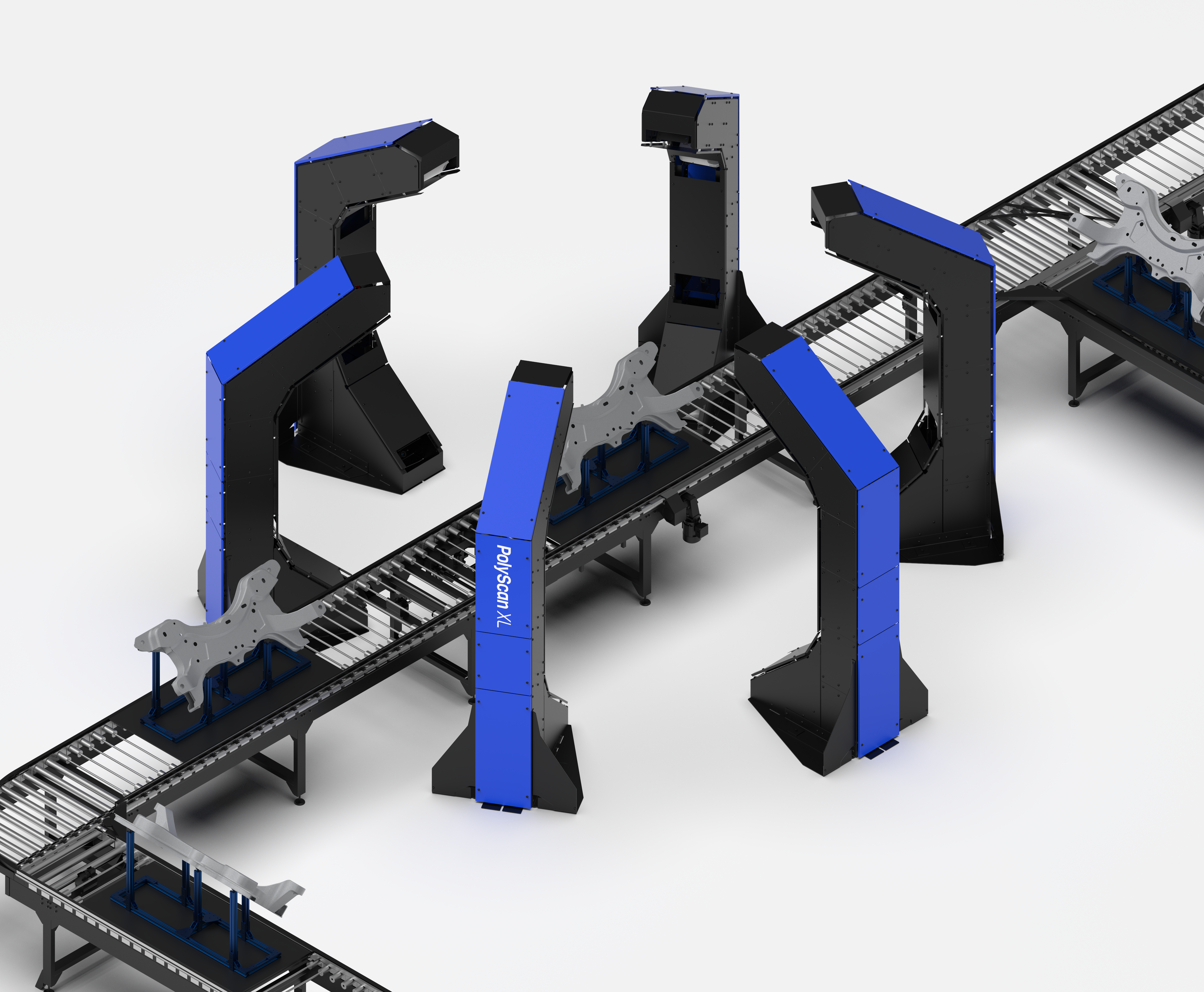
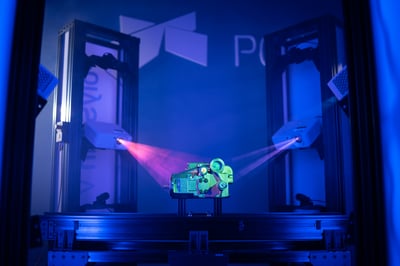 In Polyrix’s case, its motionless scanning cell uses an array of fixed cameras and structured light
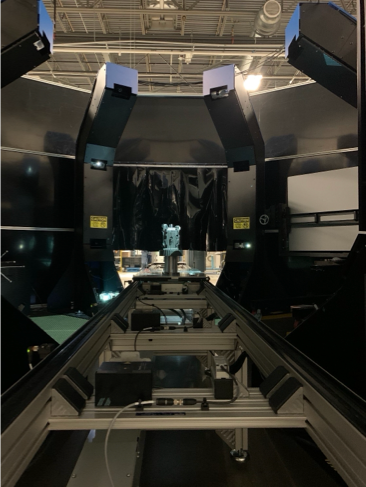
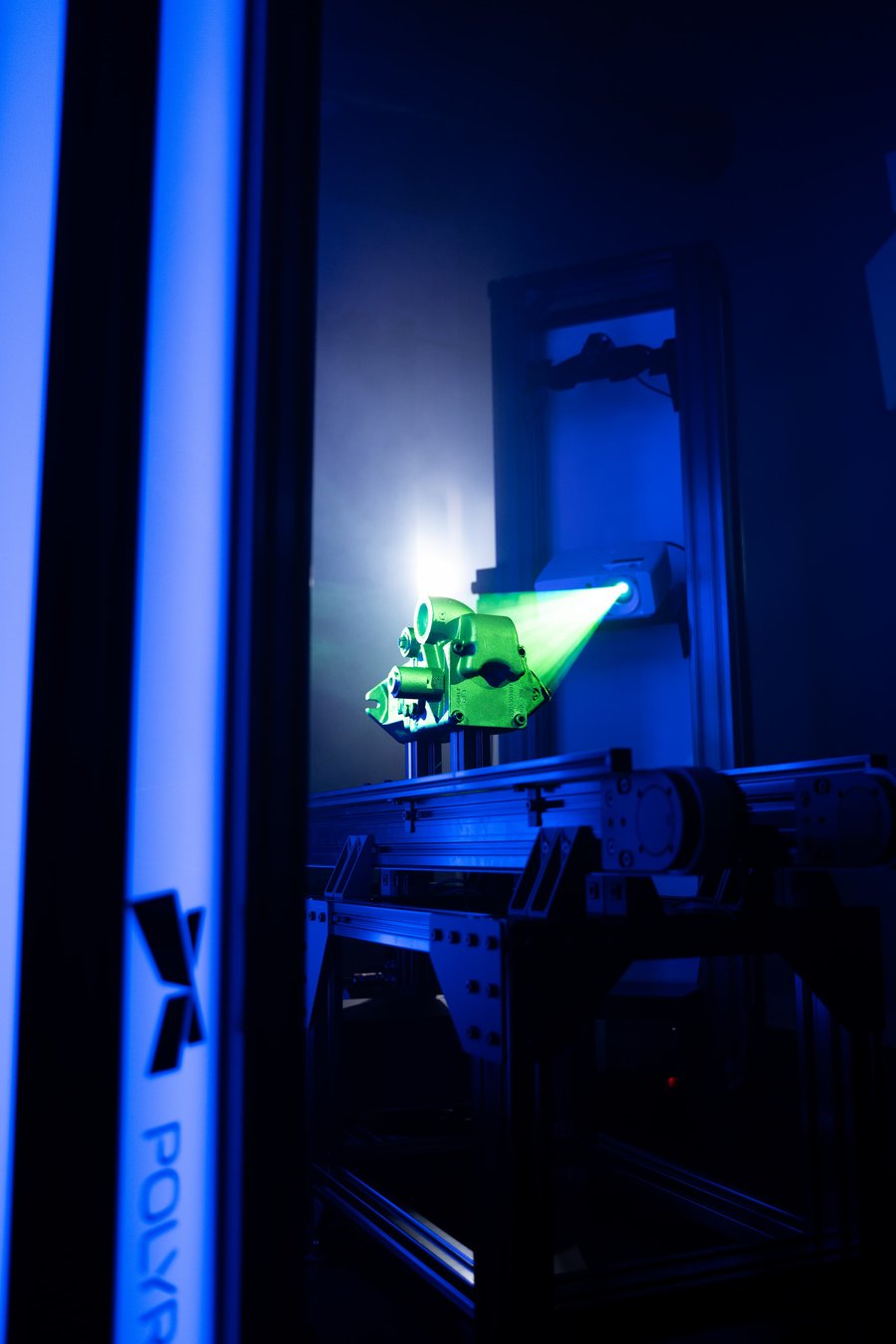
projectors arranged around the part. All sensors fire simultaneously, capturing the full surface geometry in a single scan cycle. There are no moving parts. The part moves through the cell on a conveyor or with the help of a robot; the scanner does not move at all.
Polyrix's PolyScan systems use this architecture, called Surround.Scan™, and it is the foundation of its metrology product line used inline, atline or even in metrology labs.
Head-to-Head: Five Dimensions That Matter
1. Speed
 This is where the two architectures diverge most sharply.
A robot-based scanner captures data sequentially. The arm moves to position one, scans, moves to position two, scans, and so on. Even with optimized toolpaths, full-surface coverage on a complex part requires multiple robot poses, and each pose transition adds time. On a busy automotive line with less than 60-second takt time, a robot cell typically achieves sampling inspection, not 100% coverage, because it simply cannot keep up with production throughput.
A motionless system captures all angles simultaneously. Polyrix's Fast.Scan technology, for example, achieves a complete part scan in under 30-seconds with no repositioning. Because nothing moves between parts, there is no acceleration or deceleration time, no path planning overhead, and no risk of the robot being out of position when a part arrives. The result: 100% inline scanning at production speed, not sampling.
For operations targeting adaptive manufacturing, quick feedback or thorough process control, this distinction is critical. You cannot close a real-time quality control loop on sampled data.
2. Calibration Complexity
Robot-based scanning systems require calibration across three separate components that must all be in agreement:
- The tracker (when using an external tracker to locate the robot in space)
- The robot kinematic model (the parameters describing joint positions and offsets)
- The scanner head (the intrinsic calibration of the optical sensor itself)
Each of these drifts independently. Environmental factors, such as temperature changes, cause thermal expansion in robot joints, altering the kinematic model. The tracker must be robust to those same environmental changes while maintaining its own spatial reference. The scanner head has its own calibration state.
Recalibrating a robot scanning cell is a multi-step, multi-component process. During that period, the line stops or reverts to sampling.
A motionless multi-sensor system has a fundamentally simpler calibration problem. All sensors are in fixed spatial relationships to each other, factory-calibrated as a single unit, where there is no robot kinematic model to maintain, and no tracker involved. In the case of Polyrix, its Calibration.Plus technology uses a fixed photogrammetric fiducial net and artifacts that recalibrate proactively, without stopping the production line, because the calibration routine runs within the same scan cycle infrastructure.
In practical terms: robot calibration is a scheduled maintenance event that takes the line down. Motionless calibration is a background process that does not.
3. Maintenance Cost
Moving parts break. This is not a theoretical concern, it is the dominant driver of robot-based operating costs.
For example, a 6-axis robot arm contains motors, gearboxes, encoders, cable management systems, and end-of-arm tooling. Any of these can fail. Preventive maintenance schedules for industrial robots typically call for gearbox inspections and lubrication every 3,500–5,000 hours of operation. In a three-shift automotive plant, that is roughly every six to eight months. Unplanned failures are more expensive: a gearbox replacement on a precision inspection robot, including labor and downtime, can run into tens of thousands of dollars.
Beyond the robot itself, the scanner head mounted on the robot is subject to vibration and shock from arm acceleration. Optical sensors are sensitive instruments; repeated high-G motion cycles can affect calibration stability and, in some cases, cause physical damage.
A motionless system with no moving parts has a fundamentally different maintenance profile. There are no gearboxes and no cable management systems wear from repeated motion. The failure modes are limited to light sources (projectors) and electronics, components with much longer mean time between failures and simpler swap procedures. The Polyrix design principle is straightforward: what does not move cannot break.
4. Operator Expertise Required
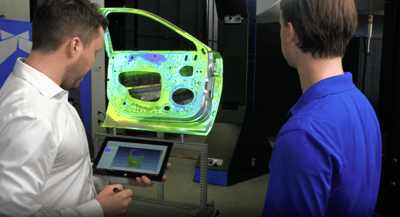 Robot-based inspection cells sit at the intersection of two highly specialized disciplines: robotics and metrology. Operating and maintaining one requires staff who understand robot programming, robot kinematics and calibration, scanner software, and the statistical methods underlying the inspection results.
Finding people who are strong in all of these areas is genuinely difficult. Most manufacturers end up with a robotics team and a metrology team who collaborate, adding coordination overhead and creating knowledge silos. When something goes wrong, diagnosing whether the problem originates in the robot system or the scanner system requires expertise in both.
A motionless scanner cell requires metrology expertise and basic system operation training. There is no robot programming. No kinematic model to understand. The operator interface is oriented toward inspection results, not motion planning. This significantly lowers the barrier to adoption and reduces the headcount and skill premium required to run the system day to day.
For manufacturers who are expanding inline inspection coverage across multiple lines or facilities, this matters enormously. You can train more people, faster, on a simpler system.
5. Part Changeover and New Part Integration
Adding a new part to a robot-based scanning cell requires developing and validating a new robot scan path. That means a programmer with robot expertise must define waypoints, check for collisions, validate coverage, and tune the path for cycle time. Depending on part complexity, this process takes days to weeks and typically requires the cell to be offline during development.
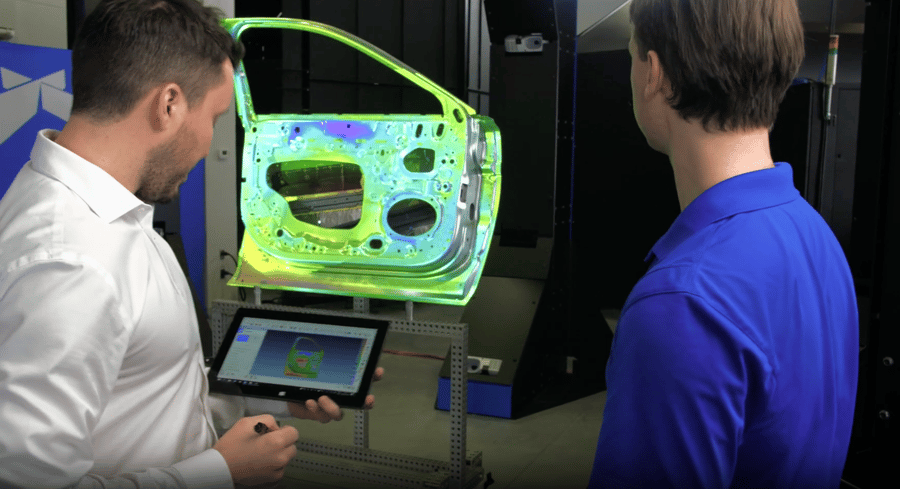
A motionless system uses a fixed sensor array. Adding a new part means defining new inspection features in the metrology software, a task performed in a digital simulation environment, not on the physical cell. Polyrix's Simulation.Lab allows engineers to validate coverage and expected accuracy before touching the production system. Cell downtime for part changeover is minimal to none.
This is a significant advantage for manufacturers running mixed-model lines or launching new programs frequently.
When to Choose Each System
| Robot-based scanning cells are a reasonable choice when: | A motionless multi-sensor system is the better choice when: |
|
|
A Practical Decision Framework
|
Criterion |
Robot-Based Cell |
Motionless Cell |
|---|---|---|
|
Inline 100% scanning at takt time |
Difficult |
Yes |
|
Calibration complexity |
High (3-component chain) |
Low (single unified system) |
|
Calibration without stopping the line |
No |
Yes |
|
Maintenance cost drivers |
Robot mechanics, gearboxes, cable management |
Electronics, light sources only |
|
Operator expertise required |
High expertise Robotics + metrology |
Low expertise Metrology |
|
New part integration time |
Days to weeks (path programming) |
Hours (software-only) |
|
Safety risk from moving components |
Yes |
None |
|
Scalability to large parts |
Yes |
Yes (multi-unit array) |
Conclusion
Robot-based 3D scanning cells are well-established technology. For offline inspection of large, complex parts where cycle time is not constrained, they are a proven option with broad vendor support.
For inline inspection at production speed, however, the motionless multi-sensor architecture offers compounding advantages: faster scan cycles, simpler calibration that does not require production stops, lower maintenance cost over the system's lifetime, and a lower operator expertise threshold that supports broader deployment across facilities.
The question is not which architecture is more capable in a demo. It is which architecture holds up under the real conditions of a production floor, temperature swings, vibration, shift changes, mixed-model runs, and the relentless pressure of takt time. In many of these dimensions, the case for motionless inspection is strong.
Interested in seeing how a Surround.Scan system performs on your specific part geometry? Polyrix's Simulation.Lab lets you validate coverage, cycle time, and accuracy before committing to hardware. Book a demo.